For engineers designing agent systems
Agentic AI design patterns (and when to use each)
Most problems people call "agent" problems are solved by a simple workflow pattern, not a fully autonomous agent. Anthropic's Building Effective Agents draws the line clearly: workflows orchestrate LLMs and tools through predefined code paths, while agents let the model direct its own process and tool use dynamically.
The discipline is to start with the simplest thing that works and add agency only when the task genuinely needs it. More autonomy buys flexibility at the cost of latency, spend, and new failure modes. This guide covers the building block, the workflow vs agent distinction, the five workflow patterns, and the one case where you actually reach for an autonomous loop.
The augmented LLM
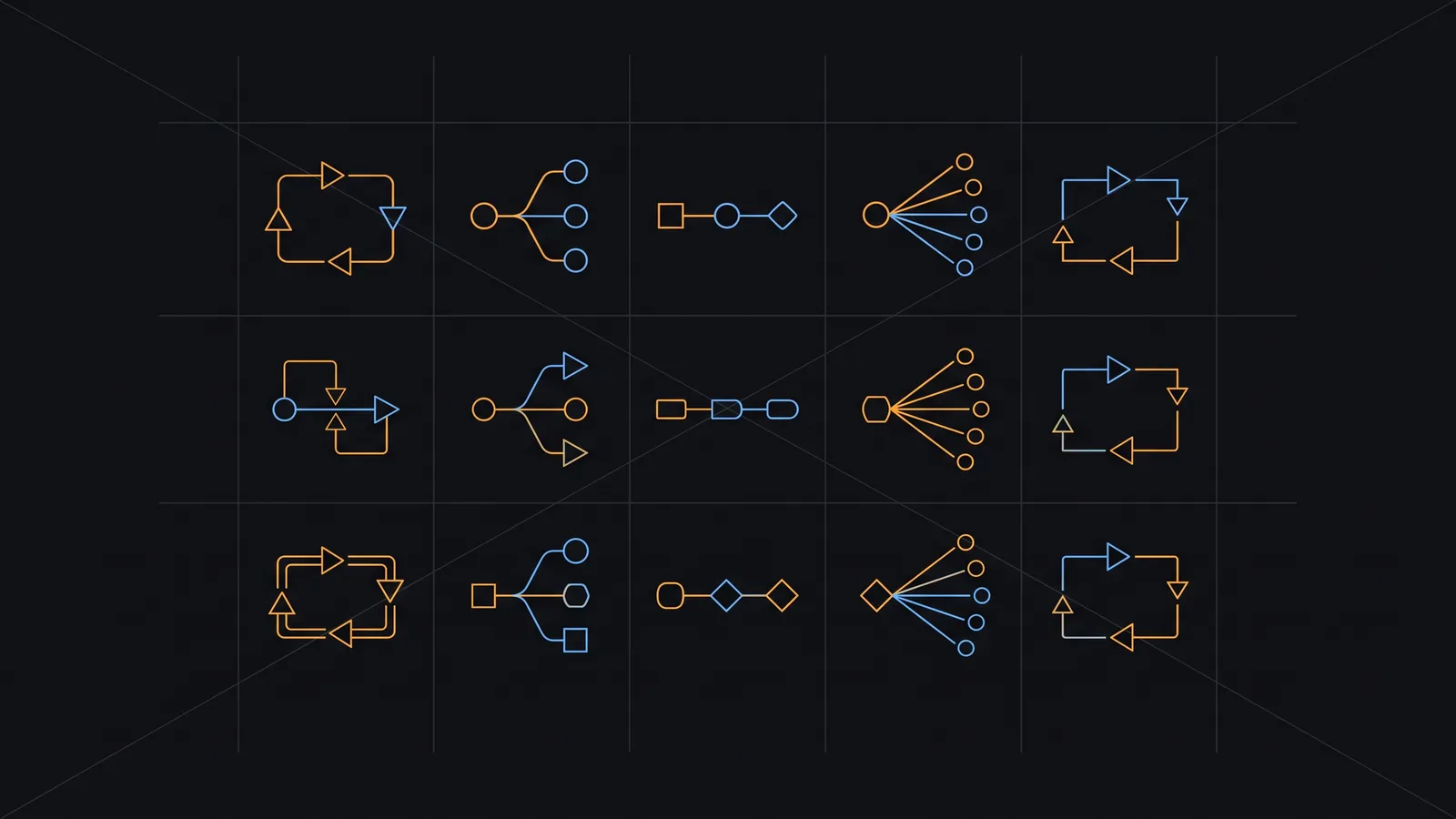
Every pattern is built from one unit: the augmented LLM, a model extended with retrieval, tools, and memory. Retrieval pulls in relevant context, tools let the model take actions or read external state, and memory carries information across steps. On its own this is already enough for many tasks. The patterns below are different ways of composing one or more augmented LLMs, so it pays to get this layer right first: clear tool definitions, scoped access, and a documented interface the model can actually use.
Workflows vs agents
The five patterns below are all workflows — predefined code paths where you, the engineer, own the control flow and the model just fills in the steps — as distinct from an agent, where the model directs its own process. See what is agentic AI for the full workflow-vs-agent distinction and the agentic loop it's built on.
The five patterns
1. Prompt chaining
What it is: decompose a task into a fixed sequence of steps, where each LLM call works on the output of the previous one. You can add programmatic checks ("gates") between steps to catch errors early.
When to use: the task splits cleanly into subtasks that always run in the same order, such as draft then translate, or outline then expand.
Tradeoff: each added step trades latency for accuracy. If the steps do not have a fixed order, chaining is the wrong shape.
2. Routing
What it is: classify the input, then send it down a specialized path. A first LLM call (or classifier) decides the category; each category has its own prompt or tool set tuned for that kind of work.
When to use: inputs fall into distinct classes that are better handled separately, such as routing support tickets, or sending easy queries to a small model and hard ones to a large model.
Tradeoff: a wrong classification sends the input down the wrong path, so the router's accuracy caps the whole system.
3. Parallelization
What it is: run multiple LLM calls at once and aggregate. Two flavors: sectioning splits a task into independent subtasks run in parallel, and voting runs the same task several times to get diverse outputs you then combine.
When to use: subtasks are independent and benefit from parallel speed, or you want multiple attempts for confidence (voting), or separate concerns handled by focused calls (sectioning, e.g. one call for content and one for a safety check).
Tradeoff: more calls mean more spend, and you need a sound aggregation rule to combine results.
4. Orchestrator-workers
What it is: a lead LLM dynamically breaks the task into subtasks, delegates each to a worker LLM, and synthesizes their results. Unlike parallelization, the subtasks are not fixed in advance; the orchestrator decides them based on the input.
When to use: complex tasks where you cannot predict the subtasks ahead of time, such as making coordinated edits across many files, or research that fans out into varying numbers of subquestions.
Tradeoff: the dynamic decomposition adds cost and a coordination layer that can itself fail; it is more involved than a fixed parallel split.
5. Evaluator-optimizer
What it is: one LLM generates a response while a second LLM evaluates it and gives feedback, in a loop, until the output meets the bar or a limit is reached.
When to use: you have clear evaluation criteria and iterative refinement adds real value, such as literary translation or research where a critique loop measurably improves quality.
Tradeoff: the loop multiplies calls and latency; it only pays off when the evaluator's feedback is reliable and the criteria are explicit.
When you actually need an autonomous agent
An autonomous agent is the right tool only when the path cannot be predefined and the number of steps is genuinely open-ended. The agent runs a loop: act (call a tool or take a step), observe the tool results from the environment, then decide the next step, repeating until a stop condition is met. Critically, that loop must be bounded. Set explicit budgets on turns and tool calls, define a clear done-condition, and give the agent ground truth from the environment (tool outputs, test results) so it can self-correct rather than drift.
Agents shine on hard, open-ended problems where you trust the model's decision-making and can verify outcomes, the classic example being a coding agent that edits files, runs tests, and iterates. They are powerful precisely because they decide their own steps, which is also why they are harder to predict, cost more per task, and need guardrails you would not bother with for a workflow.
| Pattern | What it does | Use when |
|---|---|---|
| Prompt chaining | Decomposes a task into a fixed sequence of LLM calls, each building on the last, with optional gates between steps | The task always runs as the same ordered subtasks |
| Routing | Classifies the input and sends it to a specialized path or model | Inputs fall into distinct classes best handled separately |
| Parallelization | Runs calls concurrently and aggregates: sectioning (independent subtasks) or voting (repeated attempts) | Subtasks are independent, or you want multiple attempts for confidence |
| Orchestrator-workers | A lead LLM dynamically splits the task, delegates to workers, and synthesizes results | You cannot predict the subtasks in advance |
| Evaluator-optimizer | One LLM generates, another critiques, looping until the output meets the bar | You have clear criteria and iteration measurably improves quality |
As-built: which pattern the coach actually runs
Of the six shapes above, this site's coach is neither prompt chaining nor an orchestrator-workers setup — it's the plain autonomous-agent loop, deliberately kept small. runCoachLoop in src/lib/coach.ts sends a turn, checks the stop reason, runs any requested tool, feeds the result back, and repeats, bounded by hard caps (six model turns, eight tool calls). We didn't reach for orchestrator-workers or evaluator-optimizer because the task — tutor one learner through one module — doesn't fan out into independent subtasks or need a second model critiquing the first; the "don't reach for autonomy by default" callout above is advice we followed by staying with the simplest workflow-adjacent shape rather than composing several LLM calls.
Model selection per step is a real decision here too, not just the article's framing: modelFor() in src/lib/llm.ts routes a cheap Haiku model for lightweight hints and reserves Sonnet for the tutoring turns that actually reason about a learner's answer, which is the same "cheap and fast for routing, stronger for hard reasoning" idea the reasoning-core section elsewhere on this site describes. The loop's tools are least-privilege — read due items, grade an attempt, nothing else — which is what keeps a six-turn autonomous loop safe to run unsupervised. See the bounded agentic loop pattern for the full design.
Frequently asked questions
What are AI agent architecture patterns?
They're the different ways of composing one or more augmented LLMs — a model extended with retrieval, tools, and memory — into a working system: five workflow patterns (prompt chaining, routing, parallelization, orchestrator-workers, and evaluator-optimizer) plus the autonomous agent loop for tasks whose steps can't be fixed in advance. Those six shapes are the ones this page walks through; the pattern library carries the bounded agentic loop as a production pattern — the one this site's own coach runs.
What's the difference between a workflow and an agent?
A workflow is a predefined code path — you, the engineer, own the control flow and the model just fills in the steps. An agent directs its own process: it decides what to do next based on what it observes, in a loop, until a stop condition is met. The five workflow shapes on this page are all workflows; the autonomous agent is the separate, harder-to-predict case you reach only when the path genuinely can't be predefined.
Which AI agent architecture pattern should I use?
Pick the simplest pattern on the list that solves the task, and add agency only when a fixed code path genuinely can't express the work. Chaining fits a fixed sequence, routing fits distinct input classes, parallelization fits independent subtasks, orchestrator-workers fits subtasks you can't predict in advance, and evaluator-optimizer fits iterative refinement against clear criteria. Reaching for a fully autonomous agent by default — because it sounds powerful — is the common mistake the pattern library warns against; it adds cost, latency, and new failure modes for problems a workflow already solves.
When do you actually need a fully autonomous agent?
Only when the path can't be predefined and the number of steps is genuinely open-ended — the classic case is a coding agent that edits files, runs tests, and iterates. Even then the loop must be bounded: explicit budgets on turns and tool calls, a clear done-condition, and ground truth from the environment so the agent can self-correct rather than drift. See the bounded agentic loop pattern for how this site bounds its own.
- Anthropic — Building Effective Agents (the workflow vs agent distinction, the augmented LLM, and the five workflow patterns).
- Course material: aiArch Track B (Agentic Systems) — the bounded agentic loop, budgets, and stop conditions.
- Tool-use mechanics: Anthropic's tool-use API.
This is a conceptual overview; specific API shapes change — verify against current provider docs before implementing. Corrections: hello@aiarch.dev.
Learn to design agent systems that ship.
aiArch teaches the workflow patterns, the bounded agentic loop, evals, cost-modeling, and safety as first-class skills — across Anthropic, AWS, and Cloudflare.
See how aiArch helps senior engineers become AI-native, or compare Professional Membership pricing.
Free sample — no signup · every claim cited · full curriculum with membership
Subscribe to the Brief — free. This is the newsletter, not the membership — see membership here →